If you’ve spent any amount of time in church, you’ve probably heard the word doctrine. For some, it feels intimidating—too academic, too theological, too difficult to understand. But biblical doctrine is not reserved for pastors, seminary students, or theologians. Doctrine is simply what the Bible teaches. And if you belong to Christ, what God has said matters deeply.
Many Christians today are hungry for encouragement but hesitant about doctrine, as though theology somehow makes faith cold or complicated. But the opposite is true. Sound doctrine strengthens weak hearts, steadies wavering faith, and helps us recognize truth from error in a world full of confusion.
John MacArthur once said:
“Truth is not subjective; it is absolute, authoritative, and revealed by God.”
That matters because what we believe about God shapes everything—how we worship, how we pray, how we endure suffering, and how we understand salvation itself.
In a previous post, we explored foundational doctrines related to salvation and the Christian life. But there are more essential biblical truths every believer should understand—not merely to gain knowledge, but to grow in worship.
Let’s continue building that foundation together.
Related: What Is the Gospel? A Clear and Biblical Explanation of the Good News
What Does the Bible Teach About the Trinity?
The doctrine of the Trinity teaches that there is one God who eternally exists in three distinct Persons: Father, Son, and Holy Spirit.
Not three gods.
Not one God who merely changes forms.
One God in three Persons.
This doctrine stretches our finite minds because God is infinitely greater than us. But while we may not fully comprehend the Trinity, Scripture clearly reveals it.
Jesus commanded His disciples:
“Go therefore and make disciples of all nations, baptizing them in the name of the Father and of the Son and of the Holy Spirit.” — Matthew 28:19 (ESV)
Notice the singular word name, not names. One God. Three Persons.
We also see the Trinity at Christ’s baptism: the Son being baptized, the Spirit descending like a dove, and the Father speaking from heaven (Matthew 3:16–17).
R.C. Sproul wrote:
“The doctrine of the Trinity is central to the Christian faith. To deny it is to depart from historic Christianity.”
This matters because if we misunderstand who God is, we will inevitably misunderstand everything else.
The God of Scripture is not a vague spiritual force. He is the triune God—worthy of worship, infinitely holy, and perfectly united in purpose and essence.
Related: 100+ Free Downloadable Resources for Your Spiritual Growth
What Does the Bible Teach About the Deity of Jesus Christ?
If Jesus were merely a good teacher, Christianity collapses.
If He were only a prophet, our sins remain unforgiven.
But Scripture leaves no room for reducing Christ to anything less than fully God.
John opens his Gospel with breathtaking clarity:
“In the beginning was the Word, and the Word was with God, and the Word was God.” — John 1:1 (ESV)
A few verses later, John tells us that this Word became flesh (John 1:14).
Jesus is not a created being. He is eternal.
Paul writes:
“For in him the whole fullness of deity dwells bodily.” — Colossians 2:9 (ESV)
Jesus accepted worship (Matthew 14:33), forgave sins (Mark 2:5–7), and identified Himself with the divine name (John 8:58).
John Calvin wrote:
“Christ, therefore, is called God, because He is the eternal Word, begotten of the Father before all worlds.”
Why does this matter?
Because only God could bear the full weight of divine wrath against sin.
Only God could accomplish a perfect redemption.
Only God could conquer death itself.
Jesus is not merely like God.
Jesus is God.
What Does the Bible Teach About the Holy Spirit?
Many Christians understand the Father.
Many understand the Son.
But the Holy Spirit is often misunderstood.
Some imagine Him as an impersonal force. Others think of Him merely as a feeling or emotional experience.
But the Holy Spirit is not an “it.”
He is God.
In Acts, Peter confronts Ananias:
“Why has Satan filled your heart to lie to the Holy Spirit…? You have not lied to man but to God.” — Acts 5:3–4 (ESV)
The Holy Spirit teaches (John 14:26).
He convicts of sin (John 16:7-8).
He intercedes for believers (Romans 8:26).
He seals believers for redemption (Ephesians 1:13-14).
He sanctifies. (1 Peter 1:1-2)
He comforts. (John 14:26)
He empowers. (Acts 1:8)
Sinclair Ferguson wrote:
“The Holy Spirit’s supreme ministry is to bring glory to Jesus Christ.”
This is crucial because true Christianity is not behavior modification.
The Christian life is supernatural.
No one comes to Christ apart from the Spirit’s work. No one grows in holiness apart from His power.
The Holy Spirit is not optional.
He is essential.
Related: Are You a Christian…Or a Disciple?
What Does the Bible Teach About Creation?
The opening words of Scripture answer one of humanity’s oldest questions:
“In the beginning, God created the heavens and the earth.” — Genesis 1:1 (ESV)
The universe is not accidental.
You are not accidental.
Creation is the deliberate work of an all-powerful God.
Everything that exists owes its existence to Him.
John tells us:
“All things were made through him, and without him was not any thing made that was made.” — John 1:3 (ESV)
This doctrine matters profoundly.
If God created all things, then He owns all things.
If He created us, then He defines truth, morality, purpose, and meaning.
Creation also reveals God’s glory:
“The heavens declare the glory of God…” — Psalm 19:1 (ESV)
John Calvin famously described creation as:
“The theater of God’s glory.”
That’s exactly right.
Every sunrise.
Every ocean wave.
Every star in the night sky.
Every human life.
Creation is not random machinery operating without purpose.
It is testimony.
And because God created humanity in His image (Genesis 1:27), every human being possesses inherent dignity and worth.
This doctrine anchors everything from morality to identity to worship.
Related: 4 Devotional Books That Will Invigorate Your Life
What Does the Bible Teach About the Church?
Many people today say things like, “I love Jesus, but I don’t need the church.”
That sentiment may sound spiritual, but it is not biblical.
The church is not a man-made institution created for convenience. It is God’s design for His people.
Scripture describes the church as the body of Christ:
“Now you are the body of Christ and individually members of it.” — 1 Corinthians 12:27 (ESV)
It is also described as Christ’s bride:
“Christ loved the church and gave himself up for her.” — Ephesians 5:25 (ESV)
That alone should make us pause.
If Jesus loves the church enough to die for her, we should not casually dismiss her.
Yes, churches are imperfect because sinners gather there. But the church remains God’s ordained means for worship, discipleship, accountability, fellowship, teaching, and mutual encouragement.
Charles Spurgeon wrote:
“Give yourself to the Church. You that are members of the Church have not found it perfect, and I hope that you feel almost glad that you have not. If I had never joined a church till I had found one that was perfect, I should never have joined one at all.”
That’s both honest and deeply helpful.
The church is not optional for the Christian life.
It is where believers are nourished, corrected, strengthened, and equipped.
Isolation weakens faith.
Biblical community strengthens it.
Related: The Best Christian Channels on YouTube
What Does the Bible Teach About Baptism?
Baptism is one of the clearest outward expressions of inward faith.
It does not save us.
Water cannot wash away sin.
Only Christ can do that.
But baptism is an act of obedience that publicly identifies a believer with Jesus Christ.
Paul explains its symbolism beautifully:
“We were buried therefore with him by baptism into death, in order that, just as Christ was raised from the dead… we too might walk in newness of life.” — Romans 6:4 (ESV)
Baptism points to union with Christ.
The old self is gone.
A new life has begun.
Jesus Himself commanded baptism in the Great Commission (Matthew 28:19).
Because of that, baptism is not merely a tradition—it is obedience.
R.C. Sproul wrote:
“The sacraments are visible signs of invisible grace.”
That’s helpful.
Baptism does not create salvation, but it visibly points to the saving work God has already done.
For newer believers especially, baptism can feel intimidating. Public professions of faith often do.
But obedience matters.
If Christ saved you, identifying with Him publicly is not something to avoid—it is something to embrace.
Related: What on Earth is God Doing?
What Does the Bible Teach About the Lord’s Supper?
The Lord’s Supper is far more than a church ritual.
It is a sacred act of remembrance, worship, and proclamation.
On the night before His crucifixion, Jesus instituted this ordinance:
“Do this in remembrance of me.” — 1 Corinthians 11:24 (ESV)
The bread reminds us of His body broken for sinners.
The cup reminds us of His blood poured out for the forgiveness of sins.
Every observance points backward to the cross and forward to His return.
Paul writes:
“For as often as you eat this bread and drink the cup, you proclaim the Lord’s death until he comes.” — 1 Corinthians 11:26 (ESV)
John Calvin wrote:
“The Lord’s Supper is a spiritual feast wherein Christ communicates Himself to us.”
This is not a casual snack between announcements.
It is worship.
It is remembrance.
It is examination.
It is gratitude.
The Lord’s Supper reminds believers of the staggering cost of redemption.
We are not saved cheaply.
We were purchased by the blood of Christ.
Related: Is God Angry With Sinners?
What Does the Bible Teach About the Resurrection?
Without the resurrection, Christianity is empty.
Paul says exactly that:
“And if Christ has not been raised, your faith is futile and you are still in your sins.” — 1 Corinthians 15:17 (ESV)
The resurrection is not a symbolic idea.
It is a historical reality.
The resurrection of Jesus was not a private event witnessed by only a handful of people. After rising from the dead, Christ appeared to many witnesses over a period of time. Paul writes:
“Then he appeared to more than five hundred brothers at one time, most of whom are still alive…” — 1 Corinthians 15:6 (ESV)
Jesus also appeared to the disciples, to Thomas, to women at the tomb, and later to Paul himself. Christianity is rooted in historical reality, not myth or legend. The resurrection was publicly witnessed, boldly proclaimed, and powerfully defended by those who saw the risen Christ with their own eyes.
Jesus physically rose from the dead.
He defeated sin.
He conquered death.
He secured victory for His people.
But the doctrine of resurrection includes more than Christ’s resurrection.
It includes ours.
Believers will be raised.
Paul writes:
“For the trumpet will sound, and the dead will be raised imperishable…” — 1 Corinthians 15:52 (ESV)
This means death is not the end for the Christian.
The grave does not get the final word.
John Piper wrote:
“The resurrection of Jesus is the guarantee that those who trust Him will live forever.”
That hope changes everything.
Grief still hurts.
Loss still wounds.
But resurrection reminds us that sorrow is not ultimate.
Because Christ lives, His people will live also.
Related: How to Seek Happiness in God
What Does the Bible Teach About the Second Coming of Christ?
Jesus is coming back.
Not symbolically.
Not spiritually.
Not metaphorically.
Literally. Visibly. Gloriously.
When Jesus ascended into heaven, two angels told the disciples:
“This Jesus, who was taken up from you into heaven, will come in the same way as you saw him go into heaven.” — Acts 1:11 (ESV)
That means His return is not uncertain—it is promised.
It is not symbolic—it is personal.
And it is not hidden—Scripture says it will be visible to all.
John writes:
“Behold, he is coming with the clouds, and every eye will see him…” — Revelation 1:7 (ESV)
The second coming of Christ is one of the believer’s greatest hopes.
Paul calls it:
“our blessed hope, the appearing of the glory of our great God and Savior Jesus Christ.” — Titus 2:13 (ESV)
For Christians, Christ’s return is not something to fear—it is something to eagerly anticipate.
The One who came first as a suffering Savior will return as the conquering King.
And when He comes, He will gather His people to Himself.
Paul writes:
“For the Lord himself will descend from heaven with a cry of command… And the dead in Christ will rise first.” — 1 Thessalonians 4:16 (ESV)
What a staggering promise.
Death will not win.
The grave will not hold God’s people forever.
Christ will return, and His people will be with Him forever.
Jesus Himself promised:
“I will come again and will take you to myself, that where I am you may be also.” — John 14:3 (ESV)
J.C. Ryle wrote:
“The second coming of Christ is that grand object to which all Scripture steadily points.”
That truth should shape how we live.
Because Christ could return at any time, believers are called to live watchfully, faithfully, and expectantly—loving His appearing and longing for the day when faith becomes sight.
Related: Psalm 32 Explained: The Healing Power of Confession
What Does the Bible Teach About the End Times?
The doctrine of the end times—often called eschatology—is the study of what Scripture teaches about the final events of history and God’s ultimate plan for the world.
For many Christians, this topic can feel intimidating. Charts, timelines, and debates can sometimes make end-times theology feel overly complicated. But the Bible’s purpose in teaching about the end is not to create confusion—it is to produce confidence.
God has a plan.
History is moving exactly where He intends.
And Christ will reign victoriously.
Scripture teaches that before the eternal state, there will be a future period of judgment and tribulation unlike anything the world has seen:
“For then there will be great tribulation, such as has not been from the beginning of the world until now, no, and never will be.” — Matthew 24:21 (ESV)
Yet even this reminds believers that nothing unfolds outside of God’s sovereign control.
The Bible also teaches that Jesus Christ will establish His kingdom in fullness and rule in righteousness:
“And he shall reign forever and ever.” — Revelation 11:15 (ESV)
This is the believer’s confidence: evil will not win.
Sin will not endure forever.
Satan’s rebellion will be decisively defeated.
Scripture tells us that one day every person will stand before God:
“And I saw the dead, great and small, standing before the throne… and the dead were judged by what was written in the books.” — Revelation 20:12 (ESV)
That reality should sober us.
But for those who belong to Christ, the end is not defined by fear—it is defined by hope.
God’s final promise is breathtaking:
“Then I saw a new heaven and a new earth…” — Revelation 21:1 (ESV)
And:
“He will wipe away every tear from their eyes, and death shall be no more.” — Revelation 21:4 (ESV)
This is where history is headed.
Not toward chaos.
Not toward uncertainty.
But toward restoration.
One theologian beautifully summarized it this way:
“The doctrine of the end times is not meant to produce speculation, but sanctification and hope.”
That is exactly right.
Biblical eschatology should not lead us to obsession with dates or endless debate.
It should lead us to faithful living.
To holy urgency.
To steadfast endurance.
And to joyful anticipation.
Because for the Christian, the end of the story is not destruction—
it is glory.
Final Thoughts
Biblical doctrine is not dry theology for scholars.
It is truth for ordinary Christians.
It teaches us who God is.
It teaches us who Christ is.
It teaches us why the church matters, why worship matters, why obedience matters, and why hope is secure.
False teaching thrives where biblical doctrine is neglected.
Weak faith often grows where truth is shallow.
But when believers anchor themselves in Scripture, faith becomes steadier.
Worship becomes deeper.
Hope becomes stronger.
The Christian life is not built on vague feelings.
It is built on truth.
And the more clearly we understand what God has revealed, the more confidently we can stand in a world full of confusion.
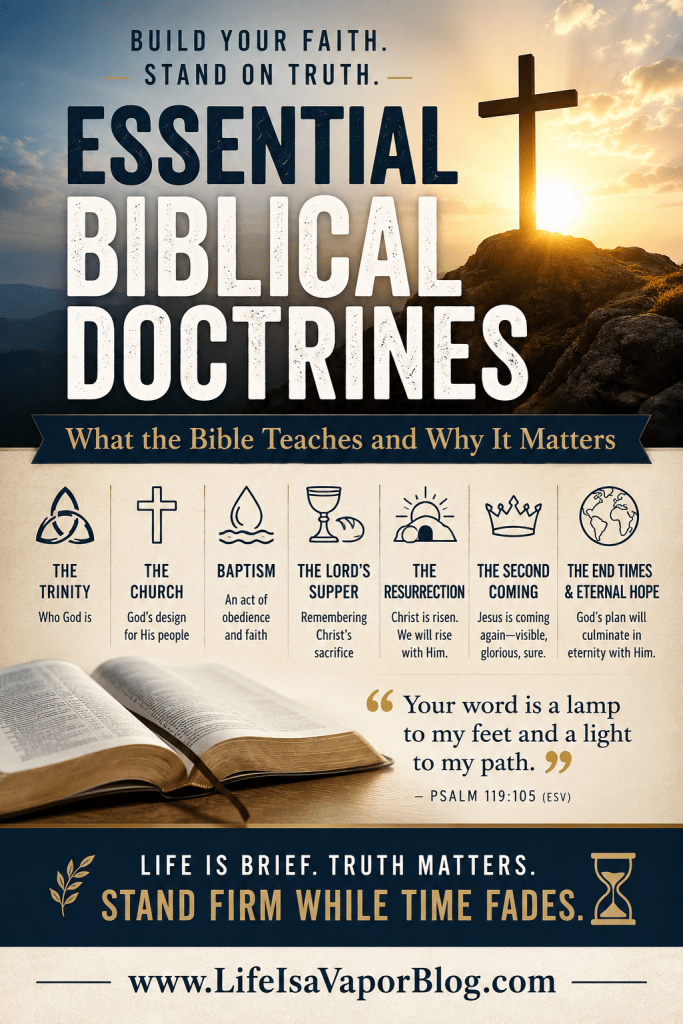
Life is brief.
Truth matters.
Stand firm while time fades.
Related: What is the Purpose of Worship?
FAQ: Essential Biblical Doctrines
1. Why is biblical doctrine important for everyday Christians?
Biblical doctrine is important because what we believe shapes how we live. Sound doctrine helps Christians recognize truth, avoid false teaching, grow spiritually, and remain grounded when life becomes difficult.
Scripture says:
“All Scripture is breathed out by God and profitable for teaching, for reproof, for correction, and for training in righteousness.” — 2 Timothy 3:16 (ESV)
Doctrine is not merely for pastors or theologians—it is for every believer who desires to know God more deeply and follow Him faithfully.
2. Can someone be a Christian without understanding every biblical doctrine?
No Christian understands every doctrine perfectly. Spiritual growth is a lifelong process.
Salvation is not based on having perfect theological knowledge but on faith in Jesus Christ.
However, believers should actively pursue biblical understanding because spiritual maturity comes through growing in truth.
Peter writes:
“But grow in the grace and knowledge of our Lord and Savior Jesus Christ.” — 2 Peter 3:18 (ESV)
A new believer may know little at first, but healthy Christians continue learning.
3. How can I recognize false teaching?
False teaching is recognized by comparing every message, sermon, book, or teaching against Scripture.
Even sincere-sounding teachers can be wrong.
The Bereans provide a wonderful example:
“They received the word with all eagerness, examining the Scriptures daily to see if these things were so.” — Acts 17:11 (ESV)
Ask:
- Does this align with Scripture?
- Does it elevate Christ?
- Does it distort the gospel?
- Is it rooted in biblical truth or human opinion?
Discernment is essential in every generation.
4. What is the difference between essential doctrines and secondary doctrines?
Essential doctrines are truths central to Christianity itself—truths that define the faith, such as the Trinity, the deity of Christ, salvation by grace through faith, and the resurrection.
Secondary doctrines are important but may involve differences among faithful Christians, such as certain views on end-times details or church practices.
Paul reminds believers:
“For no one can lay a foundation other than that which is laid, which is Jesus Christ.” — 1 Corinthians 3:11 (ESV)
Not every disagreement is equally significant, but core doctrine must remain uncompromised.
5. Where should a new Christian begin when studying doctrine?
A new Christian should begin with Scripture itself—especially foundational books like John, Romans, Ephesians, and Acts.
Start with:
- Who God is
- Who Jesus is
- What the gospel is
- What salvation means
- How Christians should live
Jesus prayed:
“Sanctify them in the truth; your word is truth.” — John 17:17 (ESV)
Strong doctrine begins with God’s Word, not human opinion.
If this article was helpful, please share it!



3 thoughts on “10 More Essential Doctrines Every Christian Should Know”