Suffering is one of the hardest realities we face in this life.
A diagnosis we never expected. The death of someone we love. A broken marriage. A child who walks away from the faith. Persecution. Financial hardship. Natural disasters. Loneliness. Depression. Betrayal.
When suffering enters our lives, one question often follows:
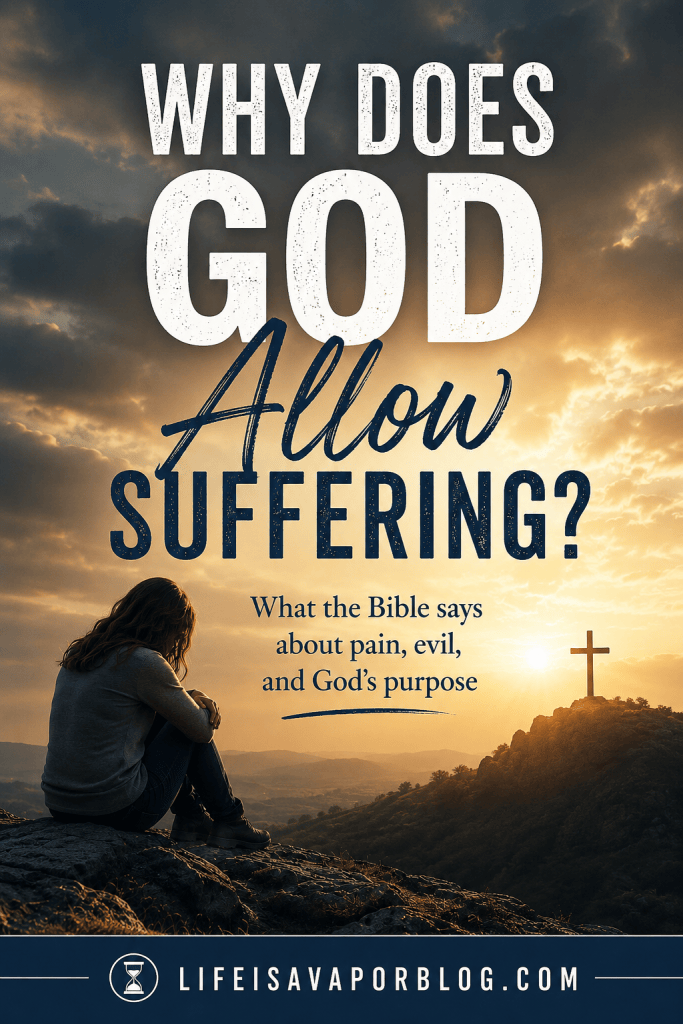
Why does God allow suffering?
If God is good, why does He allow terrible things to happen? If He is all-powerful, why doesn’t He stop evil? And if God loves His children, why does He sometimes allow them to endure tremendous pain?
The Bible doesn’t give us a simplistic answer. It doesn’t tell us that suffering isn’t really painful or that Christians should simply “think positively.” Instead, Scripture gives us something far better: the truth about God’s sovereignty, the reality of sin, the purposes God can accomplish through suffering, the cross of Christ, and the promise that suffering will not have the final word.
We may not always understand why God allows a particular trial. But we can know that He is sovereign, wise, good, and faithful.
“God never promises that we can live the Christian life without difficulty, without peril, without danger, without suffering, without calamity.”
— R.C. Sproul
Why Does God Allow Suffering? Start With Who God Is
Before we try to understand suffering, we need to understand the God who rules over it.
The Bible teaches that God is completely sovereign. Nothing happens outside His knowledge, authority, or ultimate purposes.
“Our God is in the heavens; he does all that he pleases.” — Psalm 115:3
God isn’t watching helplessly from heaven while history unfolds. He is Lord over His creation.
Paul writes:
“In him we have obtained an inheritance, having been predestined according to the purpose of him who works all things according to the counsel of his will.” — Ephesians 1:11
This includes the circumstances we understand and the circumstances we don’t.
Yet God’s sovereignty does not mean that everything that happens is morally good. God is holy and never sins. James tells us plainly that God cannot be tempted by evil and that He Himself tempts no one to sin (James 1:13).
This distinction is essential.
God can sovereignly ordain that suffering occur without becoming the sinful author of the evil involved.
The clearest example is the crucifixion of Jesus.
Jesus was delivered up according to God’s definite plan, yet the people who murdered Him were still guilty of wickedness (Acts 2:23). Acts 4:27–28 likewise says that Herod, Pontius Pilate, the Gentiles, and the people of Israel did what God’s hand and plan had predestined to take place.
The cross demonstrates something astonishing:
God can sovereignly accomplish His purposes through the sinful actions of human beings without Himself becoming sinful.
Suffering Entered the World Because of Sin
The Bible’s explanation for suffering begins with Genesis 3.
God created the world good. There was no death, corruption, pain, or rebellion in the original creation. But Adam and Eve disobeyed God, and sin entered the world.
Paul explains:
“Therefore, just as sin came into the world through one man, and death through sin, and so death spread to all men…” — Romans 5:12
The consequences of the Fall reached far beyond Adam and Eve. Creation itself was subjected to frustration and now groans under the effects of sin.
Romans 8 describes creation as “groaning together in the pains of childbirth,” waiting for the day when it will be set free from its bondage to corruption (Romans 8:20–22).
That means the world we live in is not the world as God originally created it to be.
Suffering, disease, death, injustice, violence, and natural disasters are all connected to living in a fallen creation.
This doesn’t mean that every individual suffering is the direct result of a particular personal sin. Jesus rejected that kind of simplistic thinking in John 9:1–3.
But it does mean that suffering exists because sin has brought death and corruption into God’s good creation.
Does God Cause Suffering?
This is where God’s sovereignty can be difficult for us to understand.
Scripture repeatedly teaches that God is sovereign over events that involve suffering. The book of Job provides a powerful example.
Job lost his children, possessions, and health. Yet after experiencing tremendous suffering, Job ultimately confessed God’s sovereignty:
“I know that you can do all things, and that no purpose of yours can be thwarted.” — Job 42:2
God had purposes in Job’s suffering that Job couldn’t see while he was experiencing it.
But Scripture never presents God as morally evil.
James 1:17 calls Him the giver of every good and perfect gift, while 1 John 1:5 declares that “God is light, and in him is no darkness at all.”
So we must hold two biblical truths together:
God is sovereign over suffering, and God is never sinful.
We don’t have to choose between God’s sovereignty and God’s goodness. The Bible teaches both.
Sometimes God prevents suffering. Sometimes He permits it. Sometimes He delivers us from a trial quickly. Other times He allows us to walk through it for years.
And sometimes we may never know in this life why He allowed a particular suffering.
But God’s purposes are never thwarted.
“You will never know all the benefits of the power of suffering until you realize that a sovereign God is providentially ordering everything for your good and his glory.”
— John MacArthur, The Power of Suffering: Strengthening Your Faith in the Refiner’s Fire
God Can Use Suffering for Our Good
One of the most comforting truths in Scripture is that suffering is never necessarily wasted in the hands of God.
Romans 8:28 says:
“And we know that for those who love God all things work together for good, for those who are called according to his purpose.”
Notice that Paul doesn’t say that all things are good.
Suffering isn’t good.
Cancer isn’t good. Death isn’t good. Abuse isn’t good. Betrayal isn’t good.
But God can work through even terrible circumstances to accomplish His purposes.
And verse 29 tells us what that ultimate “good” looks like: being “conformed to the image of his Son.”
God’s purpose isn’t simply to make our earthly lives more comfortable. His purpose is to make us like Christ.
Related: God Is Working for Your Good
James writes that trials test our faith and produce steadfastness (James 1:2–4). Peter says that trials can refine our faith like gold and demonstrate its genuineness (1 Peter 1:6–7).
Sometimes suffering exposes our dependence on things other than God.
Sometimes it teaches us to pray.
Sometimes it produces endurance.
Sometimes it gives us compassion for others who are hurting.
Sometimes God uses our suffering to make us more aware of our need for Christ.
We may not see what God is accomplishing in the middle of the trial. But our inability to see His purpose does not mean He has none.
What About Suffering That Seems Completely Pointless?
This may be the hardest question of all.
What about suffering that seems to accomplish nothing?
What about the child who dies? The faithful Christian who spends years battling illness? The innocent person who suffers because of someone else’s wickedness?
The book of Job reminds us that there are times when we simply will not know the reason.
Job never received an explanation for everything that happened to him.
Instead, God revealed Himself.
That is significant.
God’s answer to Job wasn’t, “Here is the complete explanation for everything you experienced.”
It was essentially, “I am God, and you are not.”
God’s wisdom is infinitely greater than ours.
Isaiah 55:8–9 reminds us that God’s thoughts and ways are higher than ours. Deuteronomy 29:29 tells us that some things belong to God and have not been revealed to us.
Christian faith doesn’t require us to understand everything God is doing.
It requires us to trust the God who does.
“Certainly it doesn’t make sense to us, no. But it does make sense to God.”
— John Piper
The Cross Gives Us the Greatest Answer to Suffering
If we want to know whether God cares about human suffering, we need to look at the cross.
Jesus wasn’t distant from suffering.
He entered it.
Isaiah prophesied that the Messiah would be “despised and rejected by men; a man of sorrows and acquainted with grief” (Isaiah 53:3).
Jesus experienced betrayal, rejection, injustice, physical agony, and death.
And yet His suffering was not meaningless.
At the cross, God accomplished the salvation of His people.
Peter writes:
“He himself bore our sins in his body on the tree, that we might die to sin and live to righteousness.” — 1 Peter 2:24
The greatest evil ever committed—the crucifixion of the innocent Son of God—became the means through which God accomplished the greatest good: the redemption of sinners.
The cross therefore gives us a profound answer to suffering.
God is able to take what appears to be meaningless tragedy and use it to accomplish His sovereign purposes.
And even more beautifully, God didn’t merely send us an explanation for suffering.
He sent us His Son.
God Promises That Suffering Will Not Last Forever
Christianity doesn’t teach that suffering is all there is.
There is coming a day when suffering will end.
Paul writes:
“For I consider that the sufferings of this present time are not worth comparing with the glory that is to be revealed to us.” — Romans 8:18
And Revelation gives us the breathtaking promise of what awaits God’s people:
“He will wipe away every tear from their eyes, and death shall be no more, neither shall there be mourning, nor crying, nor pain anymore.” — Revelation 21:4
That is our hope.
God will not merely help us cope with suffering forever.
He will ultimately destroy everything that causes it.
Death will be defeated.
Sin will be gone.
Pain will be gone.
Tears will be gone.
And God’s people will dwell with Him forever.
Related: What Will Heaven Be Like?
How Should Christians Respond When We Suffer?
Knowing these truths doesn’t mean that suffering suddenly stops hurting.
The Christian response isn’t to pretend we’re fine when we’re not.
The Psalms are filled with cries of anguish, confusion, and grief. Biblical faith gives us permission to bring our pain honestly before God.
When you suffer:
Bring your pain to God. Pray honestly. God already knows what you’re experiencing.
Trust God’s character when you don’t understand His plan. Your circumstances may change, but God’s character does not.
Remember God’s promises. When your emotions are unreliable, God’s Word remains true.
Look to Christ. He understands suffering from the inside. Hebrews 4:15 reminds us that we have a High Priest who is able to sympathize with our weaknesses.
Let other Christians help carry your burden. We were never meant to suffer alone (Galatians 6:2).
And above all, remember that your suffering is not the end of your story.
If you belong to Christ, your future is not defined by your worst day.

Three Common Misunderstandings About Suffering
1. “If God allows suffering, He must not be good.”
No. Scripture repeatedly declares God’s goodness, even while teaching His sovereignty over suffering.
We may not understand what God is doing, but we can trust who He is.
2. “If I’m suffering, God must be punishing me.”
Not necessarily.
Believers can suffer for many reasons. Sometimes suffering is the ordinary consequence of living in a fallen world. Sometimes God uses suffering to discipline and sanctify His children (Hebrews 12:5–11). Sometimes Christians suffer precisely because they are faithfully following Christ (1 Peter 4:12–16).
We should be very careful about assuming we know exactly why someone else is suffering.
3. “If I have enough faith, God will remove my suffering.”
The Bible never promises that.
Paul prayed repeatedly for his “thorn in the flesh” to be removed, but God didn’t remove it. Instead, God told him:
“My grace is sufficient for you, for my power is made perfect in weakness.” — 2 Corinthians 12:9
Sometimes God delivers us from suffering.
Sometimes He gives us grace through it.
Both are expressions of His goodness.
Related: What Does the Bible Say About Anxiety?
Frequently Asked Questions About Why God Allows Suffering
Why does God allow suffering if He is good?
God allows suffering within His sovereign purposes, and He can use suffering to accomplish purposes we may not understand. Ultimately, God promises to remove suffering completely in the new creation.
Does God cause suffering?
God is sovereign over suffering, but He is never sinful or evil. Scripture distinguishes God’s sovereign purposes from the sinful actions and intentions of human beings.
What does the Bible say about suffering?
The Bible teaches that suffering entered the world through sin, that God remains sovereign over it, that He can use trials for the good of His people, and that suffering will ultimately be defeated through Christ.
Why does God allow innocent people to suffer?
The Bible teaches that no human being is completely innocent of sin, while also recognizing that people can suffer because of the sins of others and because we live in a fallen world. Scripture does not give us a simple explanation for every individual tragedy.
Can God use my suffering for good?
Yes. Romans 8:28–29 teaches that God works all things together for the good of those who love Him, ultimately conforming them to the image of Christ.
We May Not Know Why, But We Know Who
Why does God allow suffering?
There are times when we simply won’t know the specific answer.
And that’s difficult.
But Christianity doesn’t ultimately rest on our ability to explain every painful circumstance. It rests on the character and promises of God.
We know that God is sovereign.
We know that God is good.
We know that sin and death are enemies.
We know that Christ entered our suffering.
We know that Jesus died for sinners and rose again.
And we know that one day, suffering will be no more.
So when you find yourself asking, “God, why are You allowing this?”, don’t be afraid to bring that question to Him.
Cry out to Him.
Trust Him.
Cling to His Word.
Look to the cross.
And remember the promise of Revelation 21:5:
“Behold, I am making all things new.”
We may not know everything God is doing today.
But we know how the story ends.
And for those who belong to Christ, it ends with no more death, no more mourning, no more crying, and no more pain.
If this article was helpful, please share it!



One thought on “Why Does God Allow Suffering? What the Bible Says About Pain and Evil”