Understanding the Freedom, Forgiveness, and Joy Found in Psalm 32
Why Psalm 32 Confronted My Heart
In my mid-twenties, I came face to face with Psalm 32.
It made me uncomfortable. I forced myself to read it once… then again… then a third time. The more unsettled I felt, the more I was drawn to the words. Something wasn’t right in my heart. Sin had quietly taken up residence there. I had grown accustomed to it — until the light of God’s Word exposed it.
It was painful. But it was holy pain.
And I am eternally grateful.
Psalm 32 taught me something life-altering: confessing your sins is the doorway to healing, joy, and restored fellowship with God.
Let’s read these words together:
Psalm 32:1–5
Blessed is the one
whose transgressions are forgiven,
whose sins are covered.
Blessed is the one
whose sin the Lord does not count against them
and in whose spirit is no deceit.
When I kept silent,
my bones wasted away
through my groaning all day long.
For day and night
your hand was heavy on me;
my strength was sapped
as in the heat of summer.
Then I acknowledged my sin to you
and did not cover up my iniquity.
I said, “I will confess
my transgressions to the Lord.”
And you forgave
the guilt of my sin.
What Does “Blessed” Mean in Psalm 32?
The word blessed means deeply happy — settled, relieved, at peace.
Happy is the one whose sins are forgiven.
Happy is the one whose guilt is removed.
Happy is the one who no longer hides.
We rarely connect our unhappiness to unconfessed sin. More often, we blame circumstances, other people, or unmet expectations. But Psalm 32 gently exposes something deeper: hidden sin steals joy.
Related: Is God Angry With Sinners?
What Happens When We Refuse to Confess Our Sins?
David describes what silence felt like:
- His bones wasted away
- He groaned all day long
- God’s hand felt heavy
- His strength was drained
David describes the physical and spiritual exhaustion that comes from hiding sin.
Unconfessed sin is not spiritually neutral. It affects our relationship with God. It burdens the conscience. It robs peace.
If we belong to Him, He will not let us remain comfortable in rebellion. The heaviness is mercy. The conviction is grace. It is the Holy Spirit drawing us back.
Confess your Sins and Submit to The Holy Spirit
Confession is not merely informing God of what He already knows.
It is agreeing with Him.
It is stepping into the light instead of covering our iniquity. It is naming the sin plainly, without excuse or self-justification.
When David said, “I acknowledged my sin to You,” everything changed. Forgiveness came. Relief followed. The burden lifted.
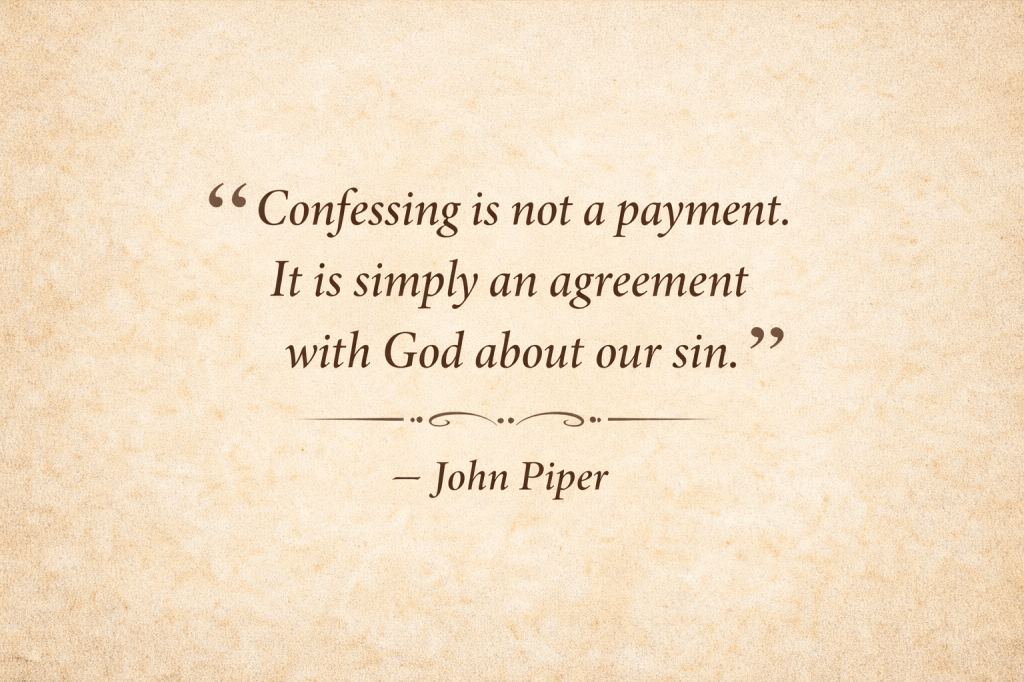
When we confess our sins, we open the door to freedom.
Related: What Does it Mean to be Born Again?
The Difference Between Worldly Sorrow and Godly Sorrow
Scripture says:
“Godly sorrow brings repentance that leads to salvation and leaves no regret, but worldly sorrow brings death.” (2 Corinthians 7:10)
Worldly sorrow feels terrible about consequences.
Godly sorrow grieves because it has offended God Himself.
The difference is profound.
Oswald Chambers wrote:
“Repentance does not bring a sense of sin, but a sense of unutterable unworthiness… Repentance always brings a man to this point: I have sinned.”
True repentance humbles us. It strips away pride. It brings us face to face with the holiness of God — and the depth of our need.
And yet, this humbling leads to joy.
Because forgiveness follows.
Related: Can I Lose My Salvation?

Confession Restores Joy and Fellowship with God
Matthew Henry described forgiveness as a burden lifted — like a heavy load removed from weary shoulders.
That is what confession does.
It restores fellowship.
It renews intimacy.
It clears the conscience.
When we confess our sins and turn from them, we are not cast away — we are cleansed.
We are clothed in the righteousness of Christ.
We stand justified before the Father.
We walk forward lighter than before.
Psalm 32 shows us that the pathway to happiness is not hiding — it is honesty.
Not silence — but surrender.
Not self-protection — but repentance.
The sorrow that felt crushing becomes joy restored.
Blessed — deeply, truly happy — is the one who confesses and is forgiven.

Why Confessing Your Sins Leads to Healing and Freedom
Healing begins when we stop covering what God is uncovering.
Freedom comes when we bring into the light what has lived too long in shadow.
Confession is not punishment — it is invitation.
It invites us back into right relationship with the One who already knows, already sees, and already stands ready to forgive.
The hand that felt heavy becomes the hand that lifts.
The sorrow that felt crushing becomes joy restored.
Blessed — deeply, truly happy — is the one who confesses and is forgiven.
Related: God Disciplines Those He Loves
Conclusion: The Joy of a Cleansed Heart
Psalm 32 is not merely about guilt — it is about grace.
It reminds us that the weight of sin is real, but so is the relief of forgiveness. The conviction of the Holy Spirit is not cruelty — it is kindness leading us home.
If your heart feels heavy today, do not hide.
Confess your sins.
Agree with God.
Turn from what has entangled you.
And you will find what David found — joy restored, fellowship renewed, and the quiet happiness of a heart made clean.
Blessed is the one whose transgressions are forgiven.
If this stirs questions in your heart about confession, repentance, or forgiveness, you are not alone. Below are a few common questions that often arise when we begin walking this path more honestly before God.
Frequently Asked Questions About Confessing Your Sins
Is confessing your sins the same as repenting?
Confession and repentance are deeply connected, but they are not identical. Confession means agreeing with God about your sin — naming it honestly and bringing it into the light. Repentance goes further. It involves a change of heart that results in turning away from that sin. True confession softens the heart; true repentance redirects the life.
Do I need to confess my sins to another person?
Forgiveness comes from God alone when we confess our sins to Him (1 John 1:9). However, Scripture also speaks of confessing to one another for the sake of prayer, accountability, and healing (James 5:16). While no human grants absolution, wise and trusted believers can help us walk in freedom and obedience.
Why do I still feel guilty after confessing my sins?
Lingering guilt often comes from difficulty accepting grace rather than from a lack of forgiveness. When we genuinely confess and repent, God forgives completely. Sometimes our emotions lag behind truth, and we must anchor ourselves in what Scripture declares rather than in what we feel. Over time, as we rehearse God’s promises, peace replaces accusation.
Does God forgive repeated sins?
God’s mercy is not exhausted by our weakness. When repentance is sincere, His forgiveness remains available — even when we struggle repeatedly. However, ongoing confession should be accompanied by a growing desire to fight sin, seek accountability, and pursue holiness. Grace is not permission to continue in sin; it is power to overcome it.
How often should I confess my sins?
Confession is not meant to be occasional or reserved for dramatic failures. It is part of the normal rhythm of the Christian life. As the Holy Spirit brings conviction, we respond quickly and humbly. A tender conscience that regularly comes before God is not a sign of weakness — it is a sign of spiritual health.

Confession may feel difficult, but it is one of the most beautiful gifts God has given us. Through it we experience the relief of forgiveness, the joy of restored fellowship, and the freedom of a cleansed heart.
If this article was helpful, please share it!

Pin for later!

♥ Are you a Christian Single? Here’s a great – and safe – way to meet people! Check out Christian Cafe! You won’t regret it! ♥

Bibles, books, music, gifts and more! Click here to browse!

 Life is a Vapor
Loved this! Well written. I loved the use of the.commentary also as not many people still use them. I related to this on so many levels.
LikeLiked by 1 person
Thanks so much for reading! I find that articles are more credible when there are good sources added. I am also leery about just posting my opinion.
LikeLike
This is an excellent post. I particularly liked this bit “Confessing our sin is much more than telling God about our sin. It is recognizing the power that sin has had over us, and how it has coursed through our veins for too long.” It definitely is a recognition of that, and that we are helpless to do anything about it on our own. Even our own repentance towards God is often not quite there, or sometimes even driven by impure motives. However, it’s recognising that we even need help in repenting and being able to come to that place where we have nothing of our own to bring before God, and that we are completely dependent on Him to deliver us.
LikeLiked by 1 person
We do need help in repenting! Thanks for reading, Robert!
LikeLike
I agree with Robert. We get so wrapped up in what we want God to do for us, we “confess” without really meaning to repent. I have to admit I do that too often. Thank you for your reminder, I needed it!
LikeLiked by 1 person
Thanks for reading! God bless you!
LikeLike
Great post! Today, I confessed my sin of living to please other people more than God, and am determined now to re-focus on serving God and not focusing on trying to make everyone happy. Just instead making God happy. Your post gave me much hope that with God’s help, I can make the necessary changes to be a more blessed person!
LikeLiked by 1 person
Ah yes! That’s one I struggle with as well. Thanks for reading!
LikeLike
The humility it takes to recognize our need enough to tell God what we know He already knows – our sin – is how we find forgiveness. He’s waiting to give it – but He is also waiting for us to ask for it. The cycle of trusting Him and turning to Him that in turn builds our confidence because He is faithful is one we must always engage in. We cause our own hurt when we allow pride to keep us from “spewing the filth” as I call it – getting the sin out and allowing healing in.
It’s work. It’s faith. It’s God’s plan. Oh, if we will just remember to hold on to it!
Beautiful post Summer!
LikeLiked by 1 person
Very insightful, Angela. I can tell your comment comes from wisdom.
LikeLike
Thank you for this great post. I think we do so often look over the importance of repentance. Many times we think our sins are not that severe compared to others and we don’t think we need to confess them. Repentance is something we all need to do daily.
LikeLike
The word of God can be so convicting sometimes, for sure! I love that passage you shared from Chambers. His writing always hits me so hard.
LikeLiked by 1 person
God’s Word has convicted me on many occasions. I love the excerpts you included from the commentaries as well. This was a great read!
LikeLiked by 1 person
Confessing your sins does lead to healing and freedom! Amen! Beautiful post with many enlightening commentaries.
LikeLiked by 1 person
I love the power of repentance and how it brings freedom! The Holy Spirit is so kind to lead me to areas that I need to bring to God so I can walk in freedom. Thanks for sharing!
LikeLiked by 1 person
Great post! I love how you said “When we submit to the Holy Spirit’s work in us – convicting us of sin – we open the door to happiness, to relief, to freedom.” So true!!!
LikeLiked by 1 person
Turning our hearts through repentance is so important and something my parents taught me from their life examples. To realign our hearts to God’s will every day. Thanks for sharing these tips to healing and freedom 🙏
LikeLiked by 1 person
This is such a wonderful post! So well written and so true. I love how you explain repentance. What cleansing and freedom we forfeit when we hold onto our sin!
LikeLiked by 1 person
Hi, Summer! Thank you so much for sharing this post. Real freedom really lies deep in forgiveness and repentance. God bless you!
LikeLiked by 1 person
Awesome post sweet sister! Psalm 32 was very convicting to me, too. ‘Blessed’ is my word for 2020 and I do feel happy (joy) in the midst of everything this year.
LikeLiked by 1 person
What a privilege it is when God speaks to us through His Word! I love how this post stems from that conviction. God bless you. 🙂
LikeLiked by 1 person
Talking to God and giving Him our sin changes us. Our hearts are tenderized.
LikeLiked by 1 person
Thank you for sharing so clearly about Psal 32.I will be reading it a few times!
LikeLiked by 1 person
Such beautiful truth here, Summer. Listening to the Holy Spirit and surrendering to God through repentance brings nothing but freedom and growth. God is so good all the time – I just have to remember to lay myself down and let God be first all the time!
LikeLiked by 1 person